-

- Thunderbird Regional Business – Prague
-

- Our new city routine, January
-

- Meeting Mr. Lewis at Meadow View Ranch
Last August I entered one of the most exciting, rewarding and difficult endeavors of my adult journey. I applied and was accepted into graduate school at Thunderbird School of Global Management.
I hadn’t intended to get my master’s degree. With 12 hours in graduate level human resources and after an international assignment (when distance-learning was not as prevalent), my mother’s terminal illness and the meeting of my future husband, finishing this degree was no longer relevant and was not a priority.
After 4 transformative years working on creating a physician-focused MBA within Gallup, learning from some of the smartest health care leaders and academicians in the country, it was clear to me that if I could find a program that contained the elements of transformation that our physicians had experienced, that maybe getting my master’s degree at this stage in the “game” would be an experience and a value to my career. The elements included: self-leadership focus, management, practical application and international immersion into business in another region of the world. Finally, the program must be “virtual” or distance-based with significant components on-line.
Few programs fit this list outside of the program we had created for doctors. Thunderbird fit most of it, with a heavy focus on international business and immersion with learning about global issues.
From my first of 4 didactic weeks, I have become a passionate advocate to others of this mind-changing masters in global business. My cohort met together to launch the program for 1 week in Glendale, during which we received a hard-earned 3 credit hours. We left with our books for the next 7 months since we would now be meeting with each other and faculty via gmail, skype, phone, video and many forms of instant messaging. This redefines the way in which people relate, build relationships and with limited time and complex demands, find effective ways to do group work, learn and ultimately get good grades.
As I reflect on the past 7 months with this trimester set to finish at the end of April, I remain a passionate advocate. Additionally, I am lead to wonder about how to raise the bar for this on-demand or virtual program, and how I might facilitate dialogue regarding.
A few ideas are being shared, virtually, amongst our cohort and with faculty. These have triggered other ideas including the potential that current on-demand students, who are mostly employed in full-time positions in management and leadership, could consist of a more formal approach to mentoring full-time students or new graduates without business experience. We are all taking stock of our careers up to now, and this immersion is likely a key catalyst paired with our common goal to change the quality of the world in which we live for the better. This vulnerability could be mutually beneficial to those that have stepped from undergrad right into grad school or those with less experience in the working world.
Additionally, there must be a way to ensure that faculty in virtual programs have what it takes to create, manage and engage students virtually. This is very hard job because we are social animals. The students get social fuel from each other and assignments, but the faculty are mostly uni-directional in their roles in educating. Not only is that difficult for them but is apparent in the disconnects that result, for the student learners and the barriers that come from interactions based on discussion board posts, solely.
Finally, I wonder if by creating a bi-directional approach for virtual courses, maybe where webinars include a virtual live classroom, the ability to ensure practical learning and practical application could be better achieved. This vs. the conceptual models and information upon which our great universities were built.
In June I head to Prague with a small group from my cohort and other cohorts for 3 credit hours and an immersion into European business. In September, we head to Sao Paulo to learn about business in South America. We have the choice to go to Asia as well as South Africa and eventually Africa. As my ODXI com-padre noted last night, maybe we should go to all continents to ensure we are truly prepared to be global managers when we earn our degree?
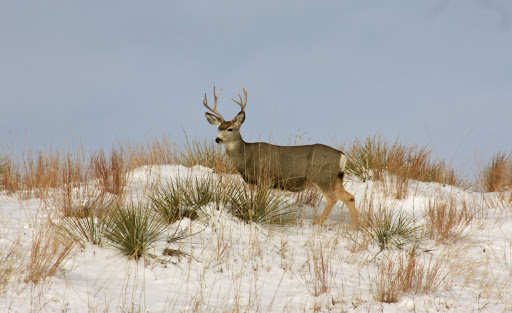
Mule deer. On the hill near my childhood ranch home.
As I reflect on the past few months, the events, responsibilities, associations and experiences are nearly solely about change. Significant change.
A move to a new city from our acreage home. A change of job for both my husband and I. A new home with new places to eat, exercise, celebrate and enjoy our dogs. New noises. New views. New creatures of the earth.
Additionally, the chapter at my childhood home at Meadow View Ranch ended in 2010. My intuitive Mother, during her dying days exactly four years ago, prepped my Father for this inevitable move to town. He will miss his big sandhill keeping him safe, his “pet” pheasants, the many mule deer who wandered through, but mostly he’ll miss his cows. However, his sprightly energy will sustain his excavation business and his old car renovation hobby.
The symbol for this period of time is Mr. Lewis, the stallion. He represents the last one to leave the ranch and through the process of building trust with him, represents that we all have fears about what the future holds. As Dad’s gift to me, he will join us in Seattle in the Spring.
Finally ,it’s not a coincidence that one of my main connections with colleagues has been centered around Change Consulting; more specifically, how to create leadership-driven systems of change. Where change is acknowledged not as an event but as milestones on the journey where all participate in the process. Its the participation in the process, that allows the soul to come along and help guide the future.

Last night we went to a friends house with dinner so we left the light on over our deck as a bit of light for when we arrive home. Even with the moonlight, our country home can be very dark at night. This morning we realized that we had forgotten to turn the lights off and would therefore have welcomed an entire tiny eco-system of sorts to set up camp on our deck. This guy (or gal) was catching what remaining flying creatures he could before the hot sun sends them all packing. The frogs of Western Iowa are much different than any frogs I saw growing up in Nebraska (only toads and the common water frogs you also see in Iowa). Whatever the type, we welcome all bugeaters who want to peacefully visit!

 Last week I thawed a rump roast, grass fed, purchased from Whole Foods some weeks ago. I grew up on a ranch on grass fed beef and now it’s the “thing”. At any rate, I wanted to make a nice dish and am a bit bored with the traditional slow-cooked roast beef of my traditional upbringing. Additionally, we have great neighbors who are regularly willing guinea pigs to my curiosity with new dishes (even such that they would eat stew in the heat of an Iowa Summer!). At 4:30pm on the day of our dinner, I found a recipe on my new favorite site: simplyrecipes.com(any website with a “Gluten Free” section is a favorite!) and began the process of preparing my treasured beef via the instructions of Carbonnade Beef & Beer Stew. While there a few improvisions, I followed this recipe pretty much to the “t” (a rare thing in my kitchen). I used baked in olive oil and sea salt, Ore Ida fries instead of noodles or potatoes and this sealed this great deal.
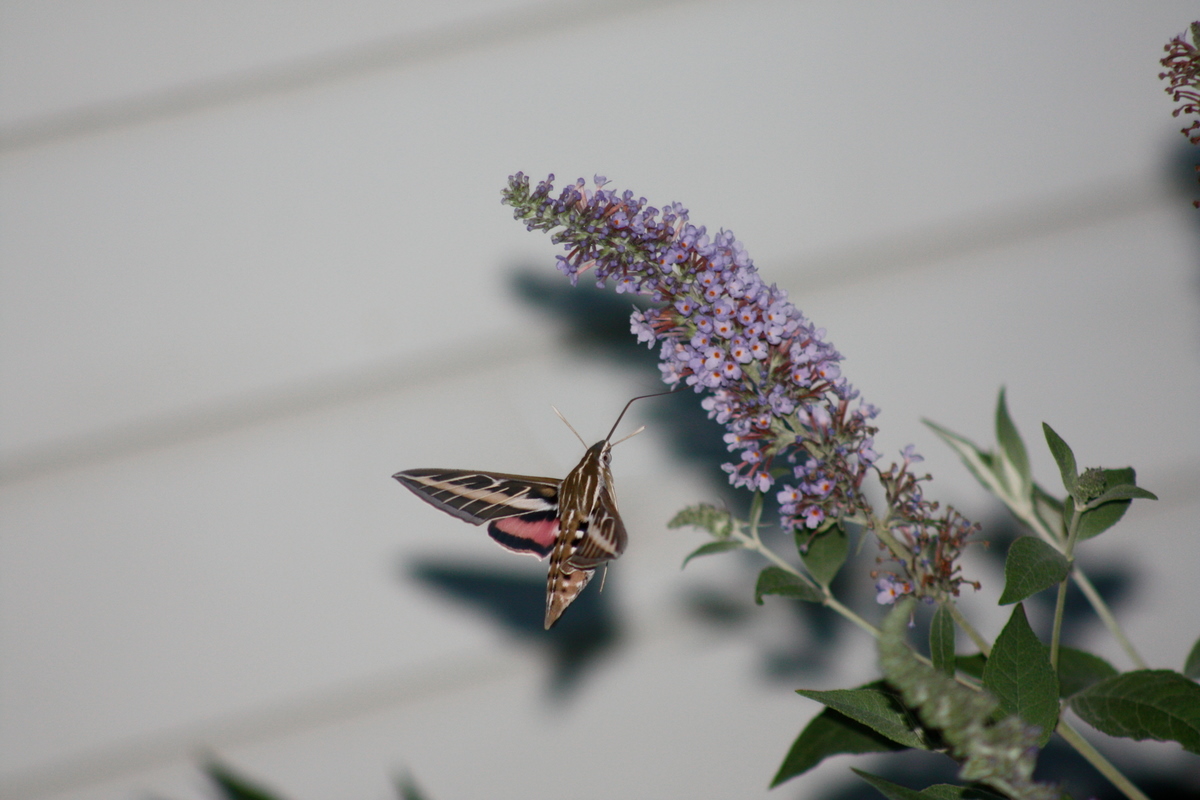
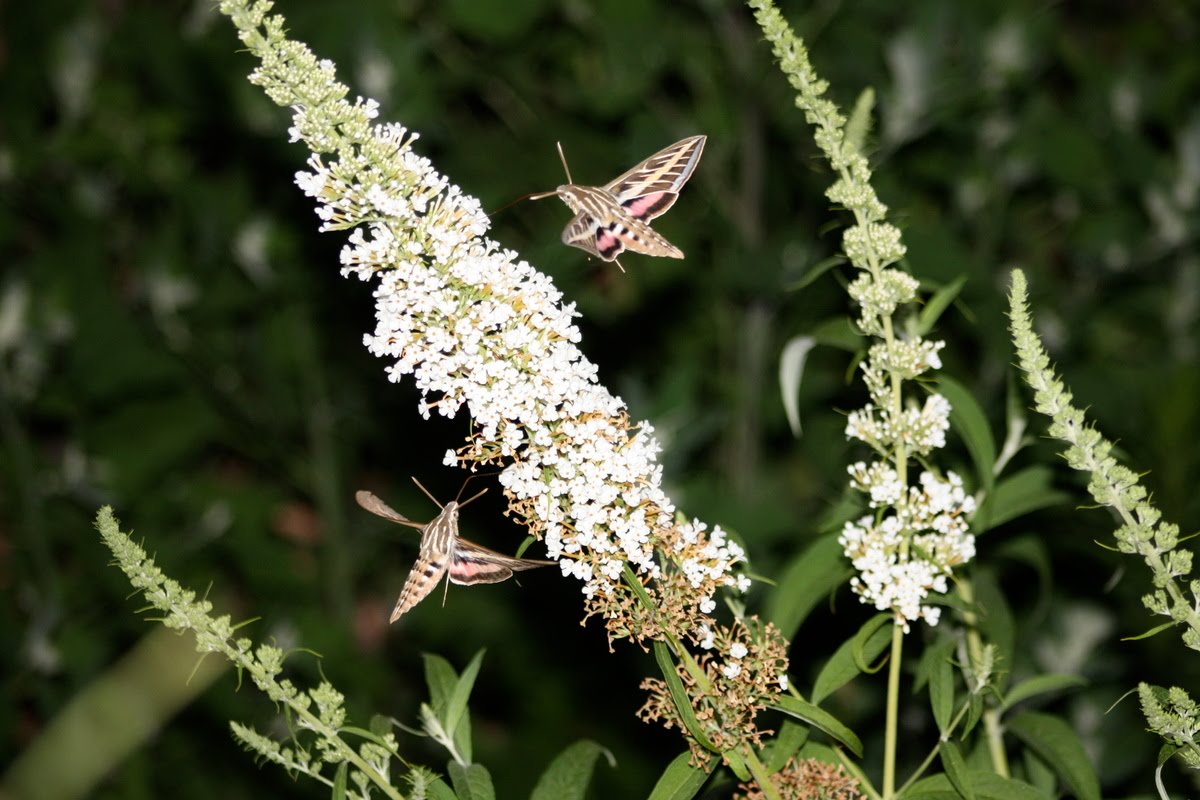 Having never seen a Humingbird, my husband and I thought that might be what were seeing an evening last week. After a very fun, multi-lens, photography session, he and I researched and realized we had a couple (at least) of White-Lined Sphinx Hummingbird Moths. We had a blast capturing these resourceful fellows. In the four summers we have lived in Western Iowa, we have never seen these before…must be all the rain!

Family: Sphinx Moths, Hawkmoths (Sphingidae)
Subfamily: Macroglossinae (Macroglossinae)
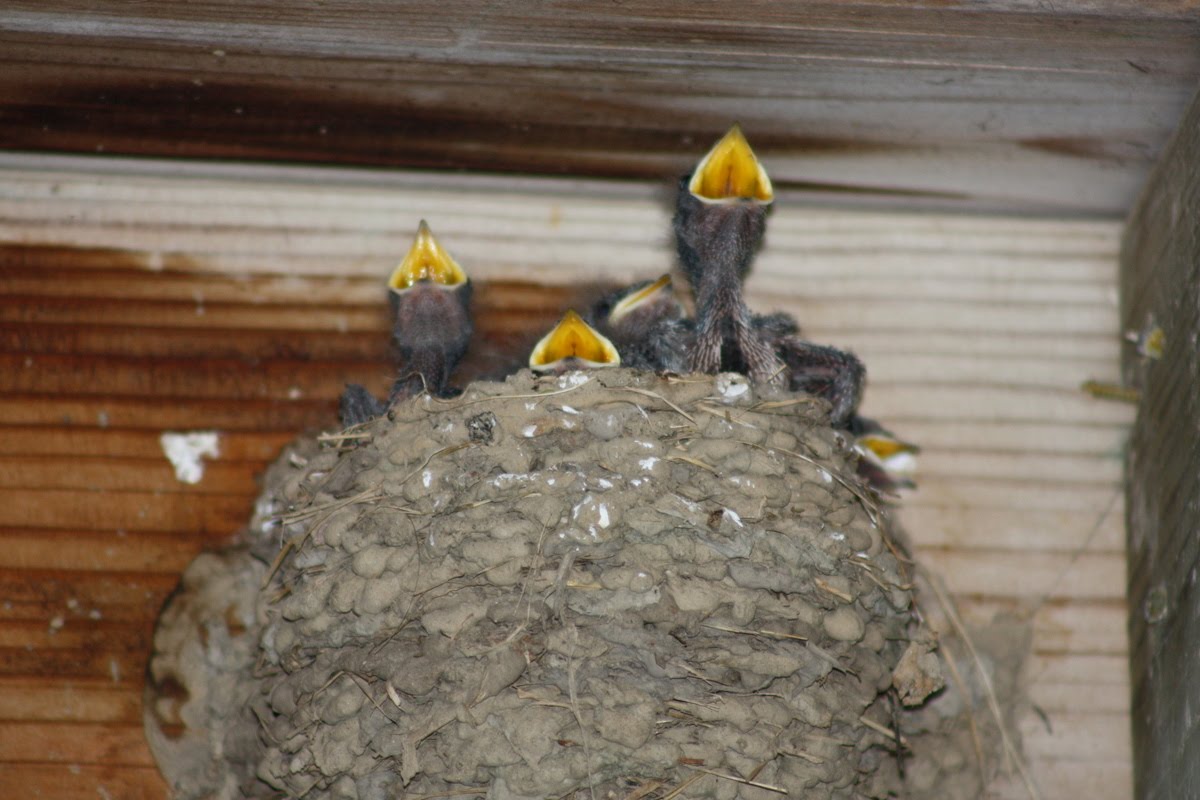 We have 5 new Barn Swallows at our house. They hatched in their mud nest (braced by a random nail sticking out of the under-frame of our deck) at the begging of this month and learned to fly within the last 48 hours. This process of getting these 5 into the world started many weeks ago however. As is frequently the case, a pair of swallows prefers a nest on our deck over our deck lights. In so many ways, these birds truly are a “friend of the farm” since they eat a ton of insects and are appealing to look at with a soft song. However, I did not want their nest on my deck outside of our door so round and round we went right light to left light and finally they found th
 eir current spot and I relinquished my efforts and began to admire the month-long process of the nest construction. We have had approximately 6 inches of rain since their mud nest was built and it is completely safe from this wet weather. There are frequent cultural references to the Barn Swallow in literary and r
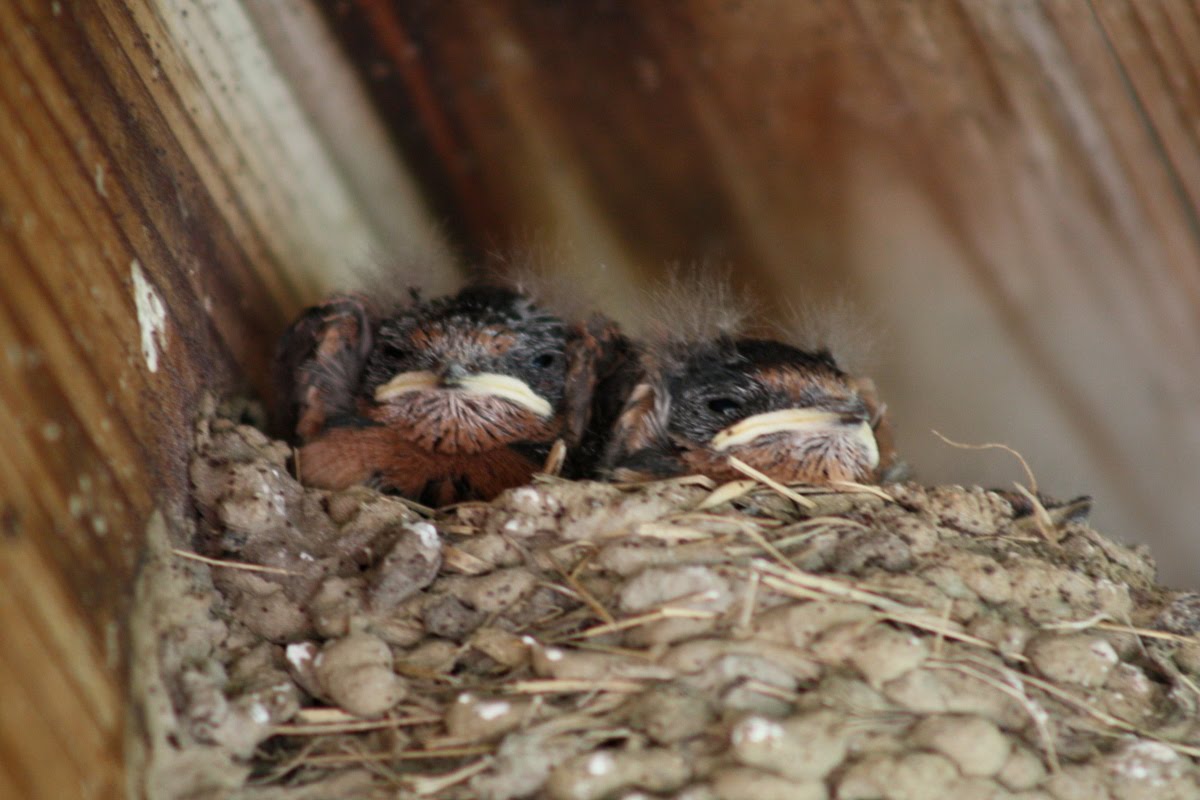 religious works due to both its living in close proximity to humans and its conspicuous annual migration. The Barn Swallow is the national bird of Estonia.
The first pictures on this post were
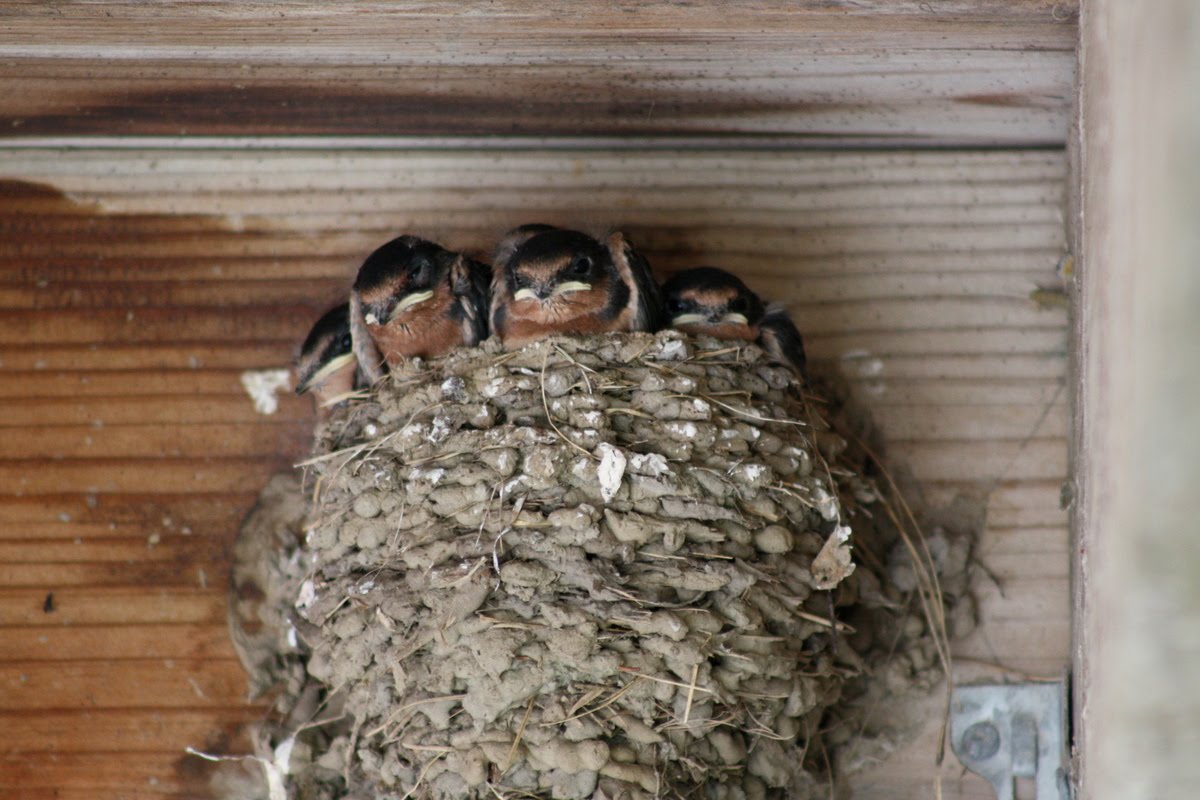 taken on July 11th and the last pictures, their day of flight were taken on the 22nd. What an amazing pace of of hatching to flying! Keerat described them as having little football helmets. It was as amazing to watch the adult birds, up to 15 at a time, keeping vigil on the power lines above. The way we see it, we have 5 more insect eaters living at our house!
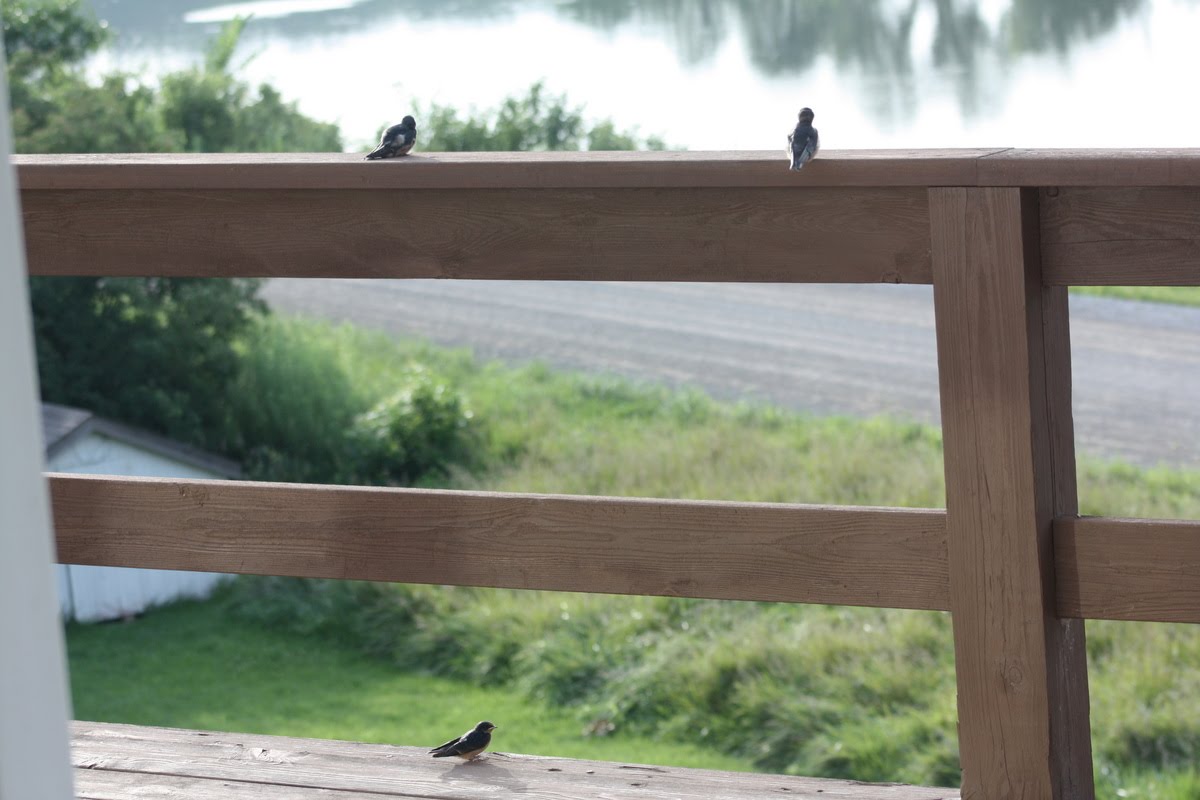
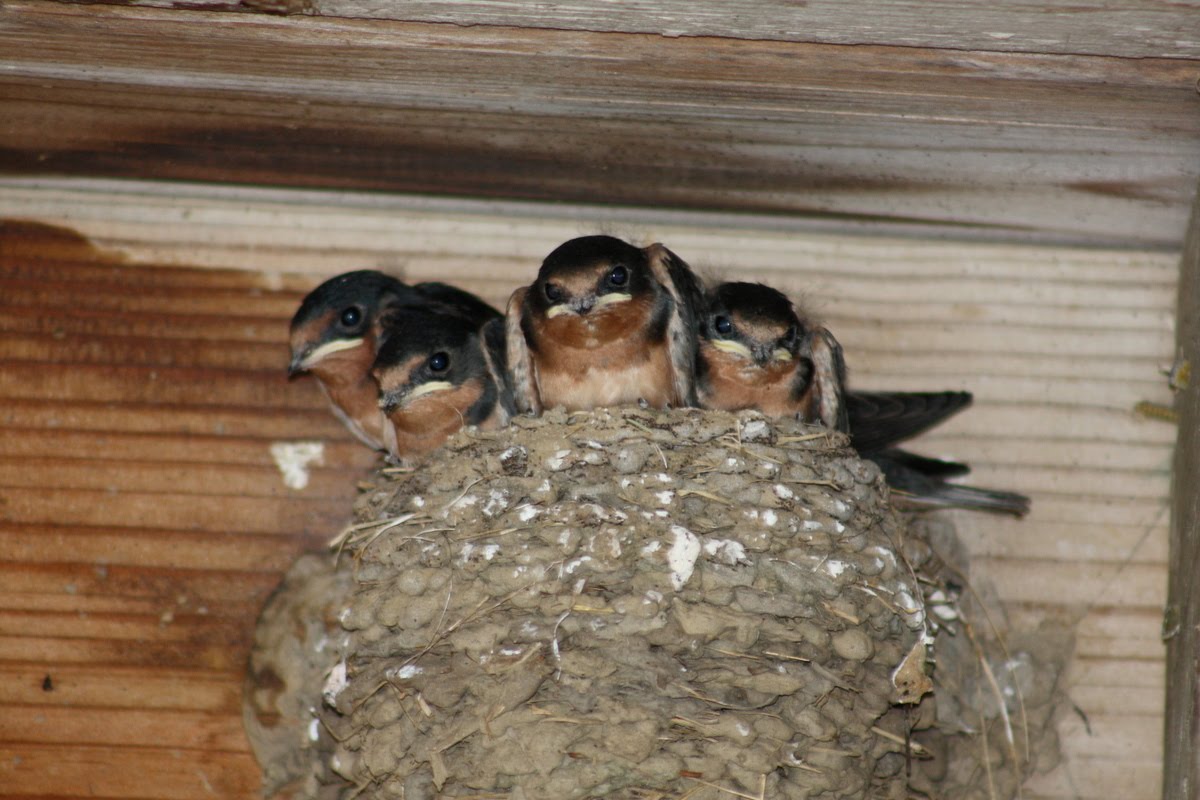 Their first day of flight took them to the deck to which their home was built. They spent all morning cleaning and arranging their new big bird feathers. There were 2 who took an extra day to leave the nest but all are officially fliers now.

Our backyard is a steep hill that is part of the unique Loess Hills. It caps into a clearing where we can see glimmers of the sun set. Never in my years of appreciating sunsets have I seen such a distinct water-color of pink, purple and blue contrasted with the black shadow of the trees. It reminded me of my grade school art classes in which we created pictures by scratching off black crayon over watercolor or marker and then it reminded of my grade school art teacher Joan, a renowned oil painter and dedicated to her talent. Maximizing your talent is sharing it with budding minds when they are most influenced in hope that even if they don’t have all of the talent to live as an artist, they will appreciate the world differently, maybe via a sunset many years later.

 big sister, Leela. He actually was a better dog during this adventure. While he was a little scared, he actually was a little more curious and a little less aggressive with his fears and trusted Steph’s commands and reassurance and grew to quite like Steph’s Aunt Arlene.Meanwhile, back home in Iowa, Leela worried herself sick and to the point of colitis. Needless to say, a trip to the vet, fasting and many meds later, Keerat had little relax and free time while the anti-social canine was running like a crazy man at the vast expanse of Clyde’s Ranch. This month, we had three separate visits of three families of friends, for a total of 8 kids between the ages of 3 and 11; two sets who stayed over night and another who came for lunch. While we got smarter about our shuffling of people, canines and cats, we do believe that our Mowgli slowly started to accept that we can have visitors come to our home. It is quite embarrassing that the hair on the back of his neck raises and his bark is backed by a growl, with every curious human. We thank Leela for the balance she brings via her great love for people and especially kids!
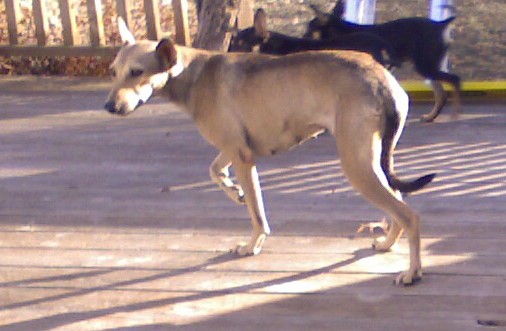 accustomed to little food the majority of her life including the months of gestation of her six pups. Once born, she would scavenge and ingest as much as she could with the mission of feeding her pups from her mouth and stomach.As with nearly all street dogs, she would teach her young very early to trust no human and to gather and save any potential items that could serve as food.
In November, Rhonda, a flight attendant from Omaha was ‘stuck’ at the Marriott in Mumbai due to the attacks that ensued late in the month. During her time there, she encountered a skinny light tan dog, as is common in India, and requested that a cab driver go and get her some food for her. He returned with chocolate chip cookies. You see, dogs are viewed as worthy as a common rat – not; therefore there is no knowledge of what food would be best and if there were, regard would be ignored. During her early interactions, she learned that this dog was with pups and soon discovered that her pups were in a trash bag to be disposed of. The two females were dead and the four males were fine, relatively.

 maximizealot